Chris Avore, smiling, arms crossed, in a navy t-shirt.

Chris AvoreNew York City Design and Product Leader

Latest writingEarning the Right to Go SmallOctober 2026

Design leadership for products that can’t afford to be wrong.

I lead design at Diligent, where I’m transforming the design function that drives a governance, risk, and compliance portfolio into an AI-native innovation engine. Previously, I’ve led large teams at Northwestern Mutual and Nasdaq, and several ICs at Meta.

At a glance

Diligent2024–
VP & Head of Design. 75 designers and researchers across 5 countries and 4 business units (Governance, Risk & Audit, Compliance, and Platform AI).
Northwestern Mutual2021–24
VP & Head of Design. Scaled the org from 60 to 120+, including Content Design, Research, Accessibility, and Experience Strategy designing for the entire insurance ecosystem including products for policy holders, advisors, and underwriters.
Meta2020–21
Product Design Manager, Recruiting Products. I led several IC designers to build and improve tools throughout the entire candidate-to-hire lifecycle, including tools for sources, recruiters, hiring managers, schedulers, and of course, the candidates.
InVision2019
Principal, Design Transformation. I helped client organizations get the most out of their design teams and improve design and product development maturity.
Nasdaq2011–18
AVP & Head of Design. Built the UX team from 1 to 35 designing tools for Investor Relations, the C-Suite, and later boardroom, risk, and trading platforms.
Author
Liftoff! Practical Design Leadership (Rosenfeld Media, with Russ Unger).
Founder
VibeSharing, a home for organizing and commenting on AI-generated prototypes.

Selected work

Case study01 / 04

Making the agentic vision visible

Organization
Diligent
Years
2025–26
Focus
AI strategy · Prototyping · Design leadership

AI changed what design teams make, with whom, and what good looks like. At Diligent I led design through that shift: working prototypes instead of decks, products that know the context and suggest the next best action, and agents that show up in Teams, Slack and text messages instead of a new app. The thread is giving people, and agents, the context to do good work. What worked, what didn't, and what's next is behind the lock.

Inside the full case

  • Prototypes that carried the vision across the company
  • Next best actions, and headless UI in Teams, Slack and text
  • What I would do differently

Case study02 / 04

Modernizing the flagship

Organization
Diligent
Years
Underway since 2025
Focus
Redesign · Information architecture · Enterprise · AI-ready foundation

A flagship product trusted by some of the largest companies in the world, redesigned without breaking anything its users depended on. I owned it end to end. The calls I made, and the ones I would make differently, are behind the lock.

Inside the full case

  • The two calls I made that went against the grain
  • Fourteen screens, and the research behind them
  • What I would do differently

Case study03 / 04

Atlas, a design system agents can read

Organization
Diligent
Years
2025–26
Focus
Design systems · MCP · AI infrastructure

More teams now build with AI through Atlas

Average calls to the Atlas MCP server per working day, by quarter. Weekday traffic now holds between 480 and 700 calls.

7366321691About 10× in two quartersQ4 2025Q1 2026Q2 2026Q3 2026
130people using it on the busiest day
Source: Internal Atlas data, October 2026.

The design system reifies intent into output

Every tool that builds UI is based on a single source, so consistency, speed, and efficiency aren’t just soundbites.

Intent
  • Product requirements
  • Prompts to coding agents
  • Figma designs
The Design System

Atlas

  • Semantic tokensOne CSS theme, light and dark
  • ComponentsBuilt in React and Angular
  • AI patternsChat, context panel, agent views
  • Rules and checksDefinition of Done, drift tracking

Served through a production MCP server and agents for Claude

Output
  • Claude Code, Cursor, Figma Make
  • Product UI across 39 products

Live Next

Source: Internal Atlas data, October 2026.

Where the system holds, and where it doesn’t yet

Products in each business unit, by the theme they run.

Risk & Audit15 products
Compliance9 products
Governance9 products
Platform5 products
Other1 product

22 of 39 products run an Atlas theme. All five new products launched this year started on Atlas.

Source: Internal Atlas data, October 2026. Bar length shows the number of products in each business unit.

The situation

A Figma library is invisible to an AI coding agent, so agents guess, and the guesses drift from the system. If agents are going to build UI, the design system has to be something they can read.

My role

I ran Atlas as a product. We shipped a production MCP server that serves tokens, patterns, and components to engineers and AI agents, with Figma-to-code parity on semantic tokens. I set code-level adoption governance: a drift taxonomy and an exception-by-approval model for custom components. When designers left other teams, I routed backfills to Atlas instead of asking for new headcount.

What changed

  • 85% of engineers use the Atlas MCP server; daily calls grew about 10× in two quarters.
  • 88% of calls are agents pulling live Atlas data.
  • 58 production-ready components in design and code; 12 native AI patterns shipped in 2026.
  • 22 of 39 products run an Atlas theme, and all five new products this year started on Atlas.

Case study04 / 04

VibeSharing

Organization
Founder
Years
January 2026–
Focus
Side hustle · Product-Market Fit · MCP functionality
  1. Ask in plain wordsThe builder tells their AI coding tool what to make and where to publish it. The tool builds the page and shares it in one step.
  2. Open the shared linkAnyone with the link can open it and use it, here by voting in a lunch poll.
  3. Pin feedback to the screenThey drop a pin on the exact spot and write the comment, the way they would in Figma.
  4. Triage from the terminalBack in the tool, the builder asks for the feedback and sets its priority and status.
  5. See it on the project pageThe comment lands on the project marked In Progress, so everyone can see it was picked up.

MCP (Model Context Protocol) is how AI coding tools such as Claude Code and Cursor call outside services.

VibeSharing publishes an MCP server, listed in the official MCP registry. The same tool that builds a prototype can publish it, read the feedback and fix what breaks, without leaving the terminal.

Each group below is one stage of a prototype's life. Each name is a command the tool can run.

Orient5

Connect and find your place

  • verify_token
  • list_collections
  • list_prototypes
  • resolve_target
  • create_collection
Design system2

Start on-brand

  • list_templates
  • get_template
Build & publish8

Get it live

  • quick_prototype
  • deploy_prototype
  • deploy_files
  • import_repo
  • share_html
  • register_prototype
  • upload_source
  • validate_project
Context5

Tell reviewers what they see

  • sync_context
  • get_prototype_context
  • add_context_link
  • list_context_links
  • remove_context_link
Feedback5

Ask, sort, and close the loop

  • generate_feedback_topics
  • get_feedback
  • triage_feedback
  • close_feedback_loop
  • create_campaign (studies)
Versions5

Iterate without fear

  • list_versions
  • rollback_deploy
  • fork_prototype
  • update_prototype
  • delete_prototype
Health & support2

Fix what breaks

  • diagnose
  • send_support_request
Prompts3

Ready-made starting points

  • write-context
  • quick-prototype
  • triage-inbox

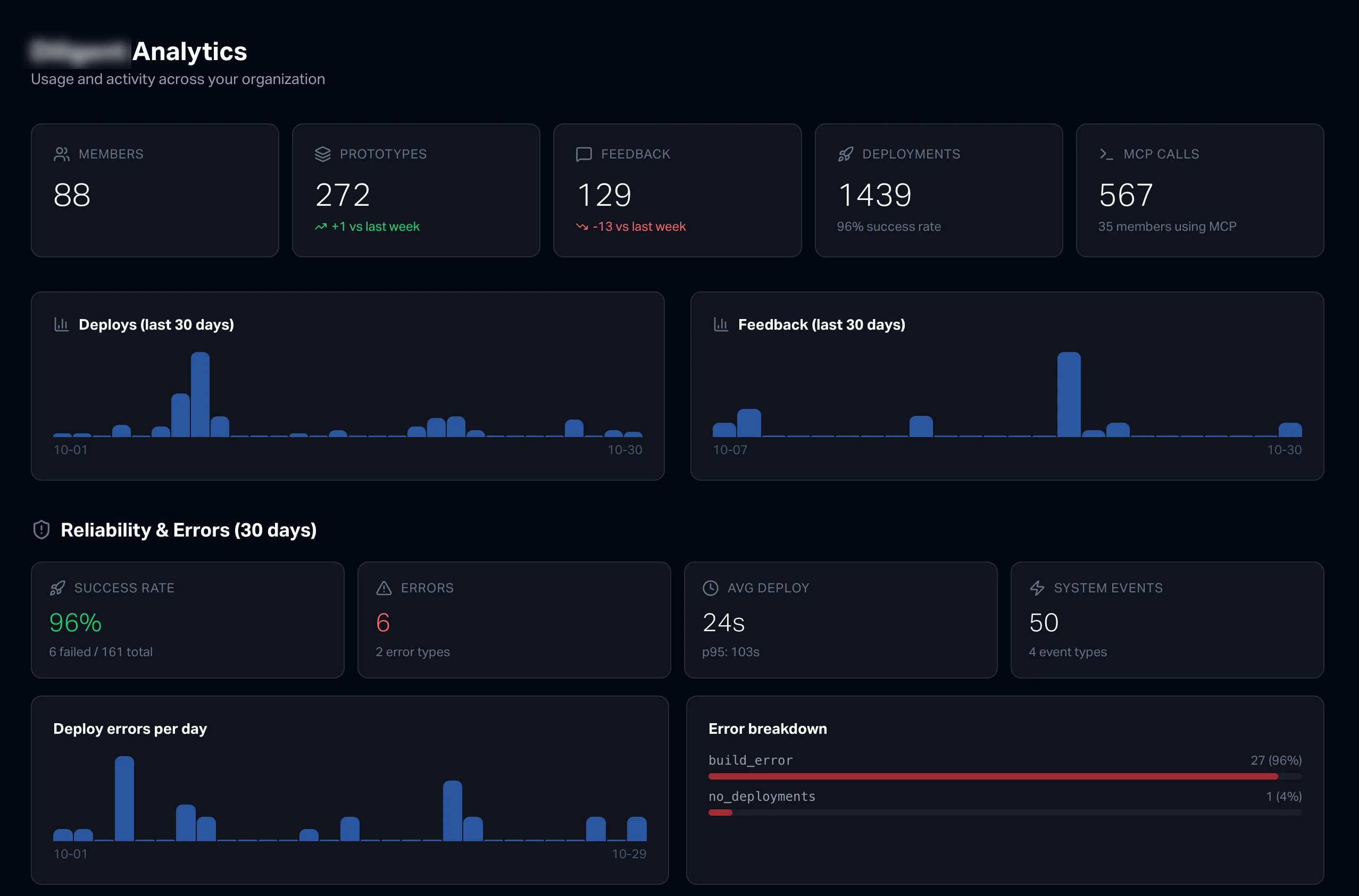
Org-wide usage for 88 members: prototypes, feedback, deploys and MCP calls.

The VibeSharing admin Analytics page for an organization. Cards show 88 members, 272 prototypes, 129 feedback items, 1,439 deployments at a 96% success rate, and 567 MCP calls from 35 members. Two bar charts show deploys and feedback over the last 30 days, and a reliability section shows success rate, errors, average deploy time, deploy errors per day and an error breakdown. The organization name is blurred.

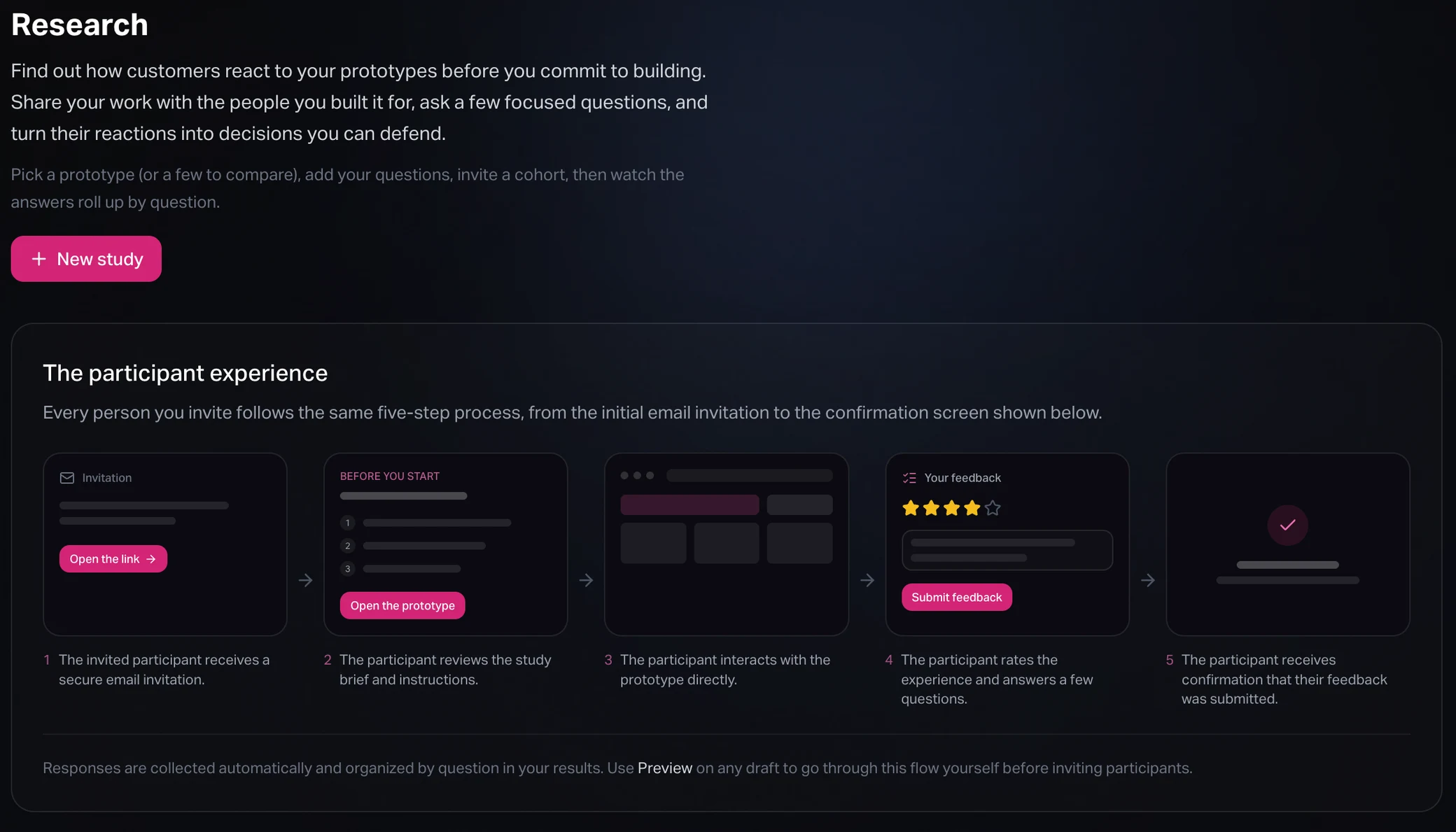
Studies turn a prototype into research: invite a cohort, ask a few focused questions, and see answers roll up by question.

The VibeSharing Research page, with a New study button and a five-step diagram of the participant experience, from the email invitation through the study brief, the prototype, a star rating and short questions, to a confirmation screen.

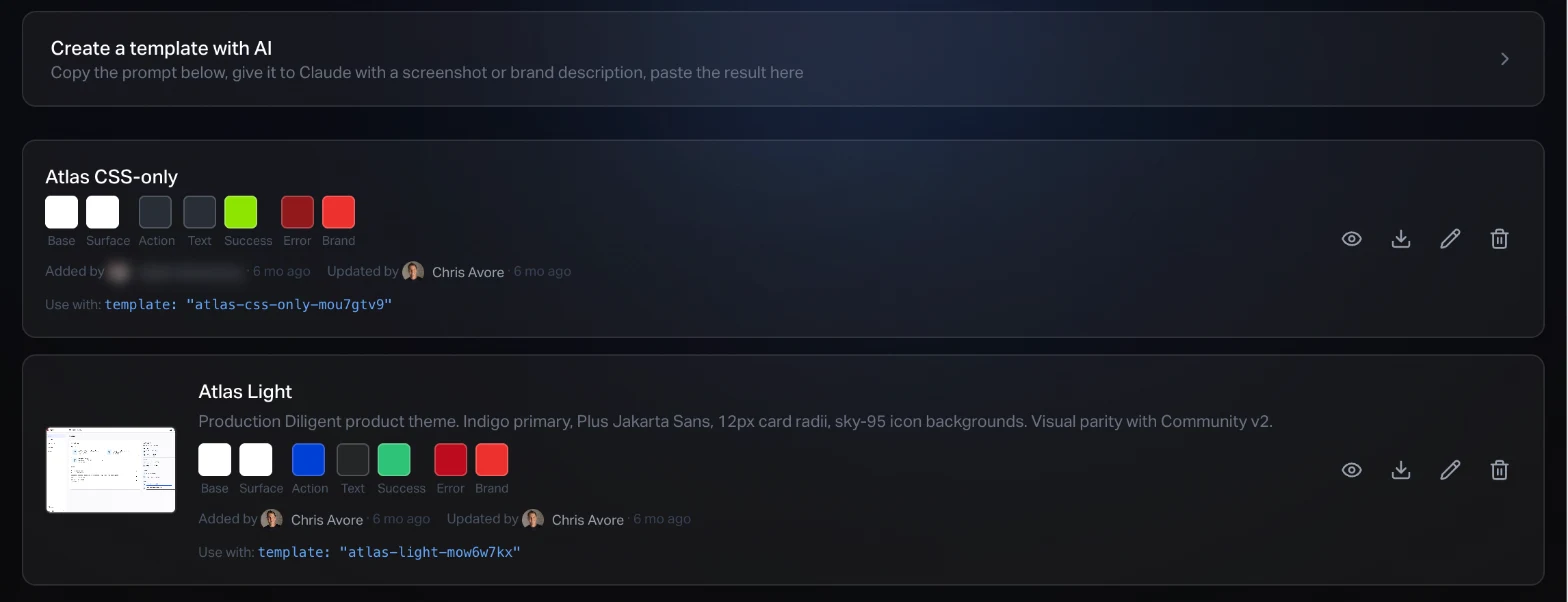
Each org keeps its own design system templates, so every prototype starts looking like the product. Reference one by its slug from any AI editor.

The Design System Templates page listing two templates, Atlas CSS-only and Atlas Light. Each shows color swatches for base, surface, action, text, success, error and brand, and a template slug to use from an AI editor. One creator's name is blurred.

The situation

VibeSharing answers the problem many product teams face that prototype with AI: how do I keep track of the latest version, and how do I leave feedback?

My role

I designed and built VibeSharing on nights and weekends with Claude Code, though it works with Codex, Lovable and other tools. Features include:

  • Easy organization of prototypes.
  • Figma-like pin-based feedback.
  • Usability tests and A/B tests, built in.
  • Stakeholder alerts on new versions.
  • A published MCP server, listed in the official MCP registry, so AI coding agents can deploy and pull design-system templates directly.
  • Every action is logged and recorded for easy auditing.

What changed

  • 200+ prototypes deployed since launch across multiple product workstreams.
  • It's also how I learned what my teams are actually up against when they build with AI.

Building cadence

JanFebMarAprMayJunJulAugSepOctMonWedFriLessMore
2,555 GitHub contributions in the last year. This graph shows January to October 2026. github.com/erova

Essays

LatestEssayOctober 2026

Earning the Right to Go Small

Leadership teams are betting that AI means smaller teams and fewer managers. The logic is half right: AI shrinks the cost of making things, not the cost of deciding, aligning, and integrating them. Here is what has to be true before small teams work, and how to test it.

  • EssayOctober 2026

    Ambiguous Expectations Increase Designer Anxiety

    Designers aren’t most afraid of being replaced by AI. They’re afraid of an undefined, ever-rising bar for what “using AI” means. Leaders can fix that by defining what good looks like at every level, and by showing a path forward that rewards the skills AI can’t replace.

  • Case studyWork from 2023

    Balancing Vision and Delivery in a Flagship Mobile Redesign

    Advancing digital client relationships in financial services by aligning long-term product vision with near-term delivery across cross-functional teams.

  • Case studyWork from 2023

    Field Experience Blueprint

    Design-led clarity for a mission-critical advisor platform

Public Speaking

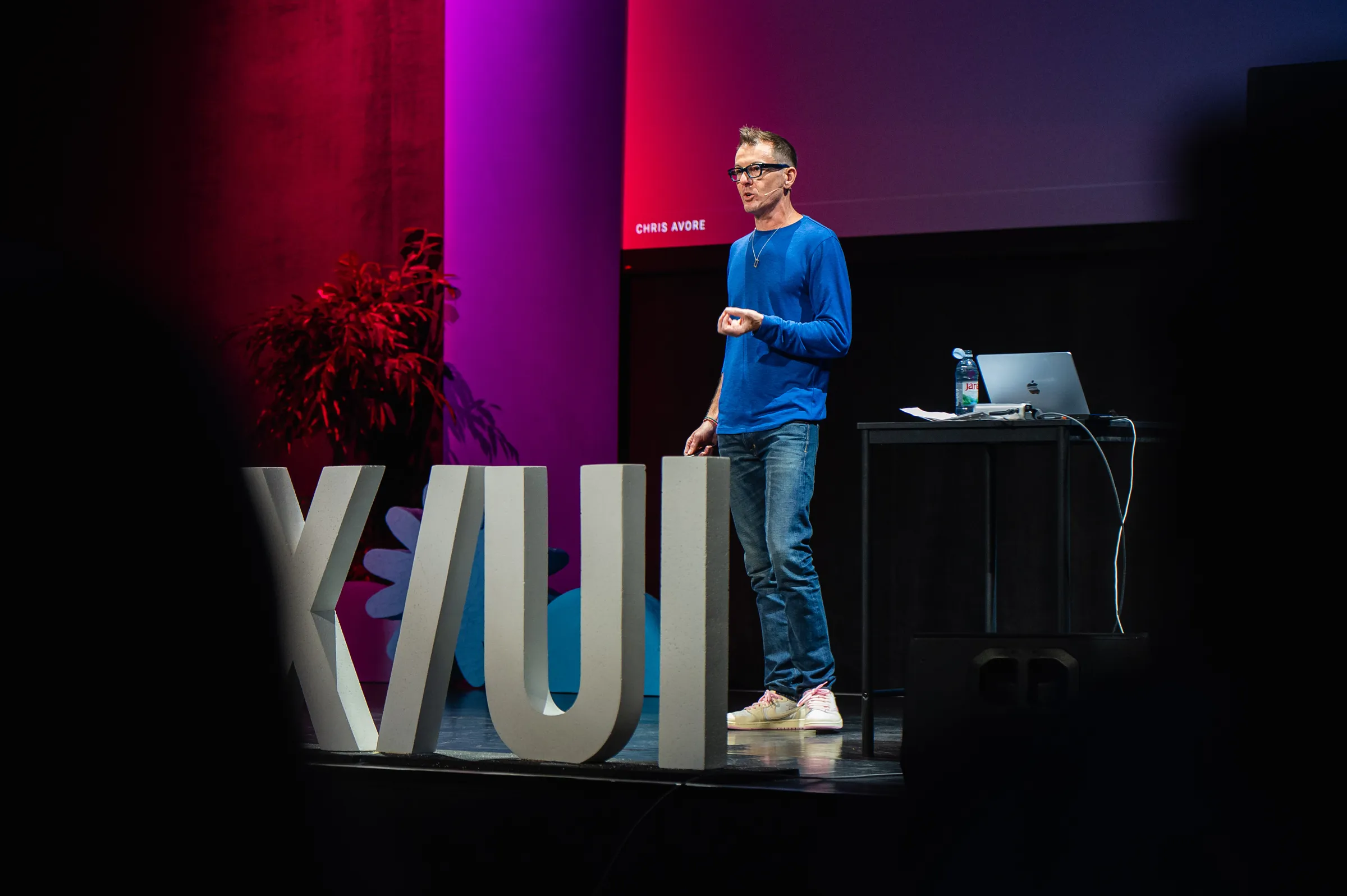
Chris Avore speaking on a stage lit in magenta and blue, in a blue sweater and jeans, standing behind oversized concrete letters, with a laptop on a table to his right.
Photo: Crafthub

Speaking since 2010: 24+ conferences in 10 countries.

Book a talk

Speaking Engagements

  • Compass AI & Tech Summit 2026
  • Dscout Co-Lab 2026
  • Design Leadership Summit 2023, 2025
  • Leadership By Design 2025
  • UXDX New York and Europe 2024
  • UX Lisbon 2023
  • Confab 2016, 2022
  • Interaction 2010–2012, 2019, 2020
  • Leading Design Festival London 2020
  • IxDA South America 2019
  • Adaptive Path MX Conference 2016
  • Adaptive Path UX Week 2015
  • IA Conference 2012, 2019

How I lead

Management scope

How many people I led, including directors who managed managers.

  1. Diligent2024–

    75 people5 directs · 5 managers · 65 ICs58 of the 75 are full-time employees.

  2. Northwestern Mutual2021–24

    120 people7 directs · 14 managers · 99 ICs

  3. Meta2020–21

    8 peopleAll direct reports

  4. Nasdaq2011–18

    35 people4 directs · 2 managers · 29 ICs

Leadership principles

Clarity

I tell my team what good looks like, and what it doesn’t. I’m direct about what design can and can’t do. When the strategy isn’t clear, I build the clarity for the team instead of waiting for someone to hand it over.

Consistency

Effective leaders are steady on good days and bad ones, and I work at it. I don’t move the goalposts on quality, and I build real partnerships with everyone, including the people I don’t naturally click with.

Curiosity

Before I react to something, I ask how it came to be. When the evidence changes, I change my mind. I try to ask more questions than I answer.

Growing leaders

A foundation you laid for me 2 years ago — I’ll always remember that.

A recent text from a former colleague, just promoted to Assistant Director. In 2024 I oversaw his move from IC to lead designer, managing 3 people.

Growth

The part of the job I’m proudest of is the people, both while we work together and after they move on. Designers I hired early in their careers have gone on to become directors at Square and VPs at Capital One, among other roles.

Retention

In 2021, half of Northwestern Mutual’s design practice had been there less than a year, with few mentors to learn from. We rebuilt career paths, and attrition fell from 36% that year to three people by July 2024. I was called a “talent magnet”: strong people I’ve worked with tend to follow me to new challenges.

Structure

I like flat organizations when the work and culture support them, but I don’t see management as overhead. At Diligent I doubled the leadership team from five to ten. The org could take on more ambiguity and complexity, and designers had someone to work through hard problems instead of going it alone.

Contact

Get in touch about design leadership roles (any size of company or team, VP title not required), speaking engagements, or the best donut you’ve ever found.

I live in Monmouth County, New Jersey, a 40 minute ferry ride from Manhattan.

chris@avo.re

LinkedInRésumé

BROOKLYNNEW JERSEYHighlandsLower Manhattan© OpenStreetMap contributors